You always wanted to know if a moustache, a monocle or a parrot would suit you?
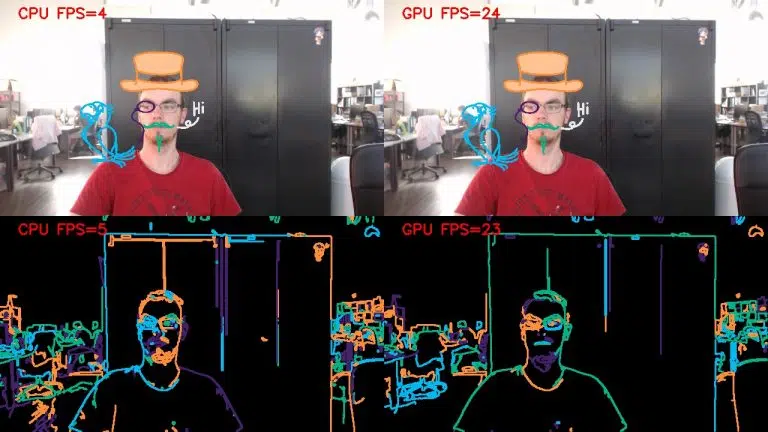
For this year’s CEBIT we have developed a showcase to compare machine learning processes with GPU and CPU computing power live and vividly: The so-called “moustache application”, which puts a moustache on your face, a parrot on your shoulder and a hat on your head. The application consists of the transmission of a video live stream that includes image processing and face recognition functions, which are trained beforehand and processed simultaneously with GPUs and CPUs.
The cascading classifier method is used for face recognition and OpenCV for implementation. The algorithm checks individual squares in a frame to see if it corresponds to a previously defined, known pattern. In addition, we use the so-called Canny method to create another effect: This is an algorithm that detects edges in an image. These two applications are good examples of machine learning, as a system has previously been trained to recognize certain patterns in order to achieve such effects.
Both processes are performed with GPUs and CPUs. The calculation with CPUs is comparable to the computing power of a standard PC. But processing with GPUs is about four to five times faster than with CPUs. In tests, the training of the network on a GPU was even twenty times faster than on the processor. The applications show clearly that a calculation with GPUs has many advantages over calculations with a processor.
Due to the constantly increasing demands on computing power, driven by technologies of artificial intelligence, virtual reality, blockchain and others, it is already foreseeable that the application possibilities for GPUs will become even more diverse in the future.
Have you become curious? At CEBIT 2018 you can try out the showcase for yourself and have your souvenir photo printed out or sent to you by e-mail! Hall 12 Booth B91.