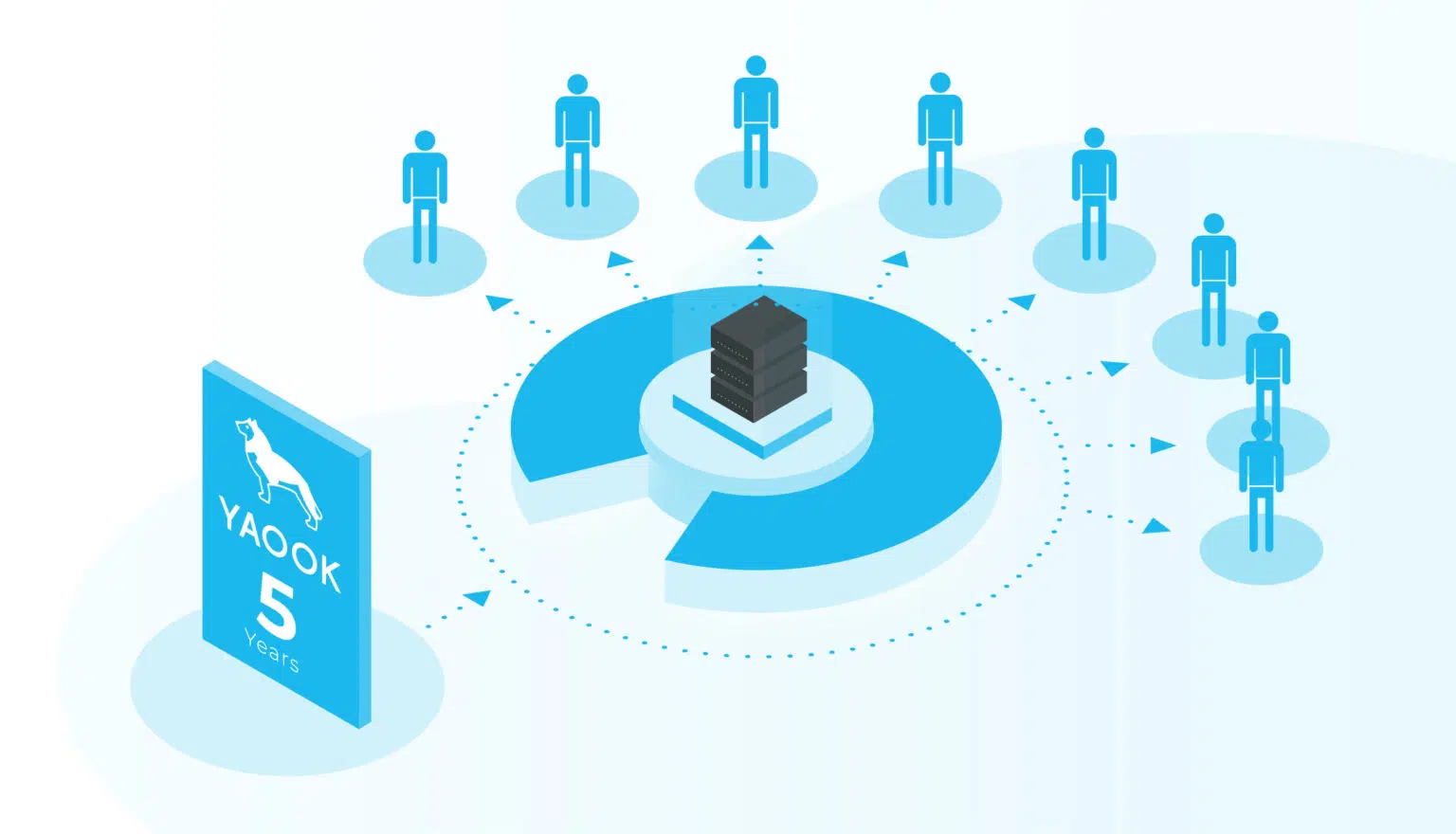
Five years ago, STACKIT and Cloud&Heat Technologies decided to open source Yaook, a lifecycle management tool for OpenStack. In the months leading up to that decision, both companies had been working intensively on the development of this tool, which provided a significant improvement to the operation of OpenStack-based cloud infrastructures.
At the time, it was not a controversial decision internally. Cloud&Heat has always been strongly aligned with open source values, extensively using and contributing to projects like OpenStack. Sharing Yaook with the community was, therefore, the natural thing to do. Personally, though, I remember having an uneasy feeling. I had just joined Cloud&Heat’s Business Development Team, and while I was aware of the widely discussed benefits of open source, I had no real experience in the field. It was difficult to come to terms with the idea that so much knowledge, time and effort would be given away for free to anyone who wanted to have it, including potential competitors.
Five years later, all uneasiness is gone. Anniversaries are always a good excuse to take a moment to look back and reflect on the implications of events and how they often extend far beyond their original context. The following reflections seek to do just that.
Open source is above all a cooperative and participative model
Open source is often described as a way to distribute software freely, but it is much more than that. The key lies in how it transforms the process of creating software components (which often have a significant impact in our society, economy and democracy) into a participative model. Instead of development happening behind closed doors within a single organization, open source invites developers and users to contribute ideas, identify bugs and improve functionality in a shared and transparent environment.
This collective approach broadens the opportunity to participate in software development, regardless of how many resources an organization can dedicate to this purpose. For instance, small and medium-sized companies like Cloud&Heat, who would otherwise struggle to free up the resources to develop large-impact software projects on their own, can pursue the task collaboratively, making important contributions that help shape the future of digital technologies. Open source fosters communities built on shared ownership and knowledge exchange, reducing duplication of effort and lowering barriers to entry for new developers. It’s hard to say what Yaook would exactly look like if it had not been open sourced, but it is safe to say that it would not be as far along as it is today in terms of feature set, documentation, maintenance and number of productive Yaook-based cloud infrastructures.
The consequence is a dramatic paradigm shift: instead of innovative software being primarily produced by large corporations with significant R&D budgets, a variety of market actors and individuals can now have a meaningful role in shaping the technology landscape. In this sense, open source is not just about access to code. It’s about rethinking who gets to define our collective digital future. In a world where software is ubiquitous and influences virtually every industry and aspect of citizens’ lives, it is key that development capabilities are not concentrated in the hands of just a few organizations.
Why governance matters: neutrality is not optional
With the growth of open source projects, another question inevitably arises: Who governs them? Over time, we have come to believe that the long-term sustainability of open source projects depends on neutral governance structures. If projects are released as open source but remain too closely tied to individual organisations, they run the risk of being constrained by that organisation's priorities, timelines or business cycles. For this reason, Cloud&Heat, together with six other companies, decided in 2022 to found the non-profit organisation ALASCA e.V., and bring Yaook under its umbrella. The idea was born out of the need to find a stable governance model that is not solely driven by the priorities of individual companies and to create a clear separation between Yaook and the surrounding businesses. The growth of ALASCA since its inception (in terms of number of projects, membership and overall community) clearly validates this decision, but that's another topic, perhaps for ALASCA's fifth anniversary next year.
It could be argued that neutral foundations are the only good alternative for leveraging the full power of open source software. While open source is often framed as a path to digital sovereignty and independence, true independence in software is unattainable. Every software component (and therefore, every product or service built on it) depends on something, whether it is the community of maintainers, the upstream projects it integrates or the standards it relies on, just to mention a few. The real question is not whether dependencies exist, but where they lie.
Clearly open source beats proprietary software at fostering independence. Proprietary technologies are black boxes and concentrate power in the hands of single vendors, making users vulnerable to unilateral technological or commercial decisions like new provisioning models or changes in licensing and pricing. In contrast, open source software increases transparency and enables dependencies to be redistributed across a broader ecosystem, avoiding single points of control. To fully realize these advantages, it is important that software projects are actually maintained, further developed and used by multiple organizations. This needs an ecosystem where no contributor is treated as a guest in the field of a hosting company, and neutral foundations are best positioned to build these ecosystems. The foundation-led approach encourages broader participation and shared ownership, and ensures that decisions, processes and code are consistently and openly documented. The result is greater transparency and ultimately reduced (or less risky) dependencies for software users.
Open source as the foundation for better products and services
Within the communities where Cloud&Heat is active (e.g. ALASCA, Sovereign Cloud Stack or OpenInfra) there is a shared view that open source is the foundation for better products and services. However, outside of these open source enthusiast communities there is sometimes a misconception that open source and commercial quality are in tension. Our experience suggests the opposite.
Cloud&Heat does not base its products on open source simply because it is convinced that this is the right way to go. Fortunately, corporate ethics and business strategy are well aligned on this issue. In addition to the fact that open source allows companies to pool resources for development purposes, it also offers other important advantages. The collaborative model associated with open source development accelerates innovation, as different perspectives lead to more robust and adaptable solutions. It also increases reliability and safety, as many contributors with different skills and perspectives can review and refine the code. So it's not just about having more developers working on a project, but also about having access to broader and more diverse knowledge, experience and perspectives.
The quality of Cloud&Heat's products and services today is based on our extensive experience in building and operating cloud infrastructures, but is also linked to the fact that the foundations of our offering are open, tested by the community and continuously improved. Of course, this applies not only to Yaook, but to our entire technology stack, including software components such as OpenStack, Kubernetes, Proxmox or Tarook. Open development creates feedback loops that are difficult to replicate in closed environments: DevOps engineers with different experiences, diverse customers and specific product offerings recognise problems earlier, continuously test decisions beyond what would be possible in a closed development approach, and share knowledge to find solutions and implement improvements faster. The end result is a more resilient software component whose benefits extend to the products and services built upon it.
To the relief of my five years younger self, using open source as a technological foundation doesn't mean you have to give up the option, A sustainable business model build. The case of Cloud&Heat (as well as many other companies in the communities we work with) shows that revenue can be generated through value-added offerings such as managed cloud services, consulting, integration work, training or operational support. Many organisations need this support because they lack the knowledge, skills or resources to manage the build and operation of a cloud infrastructure themselves, or because they choose to focus their attention on other activities that bring real value to them or their customers. The added business value of companies that work with open source results from in-depth expertise, high-quality service and convenience (which customers are willing to pay for) and not from restricting access to the code. As a business model, it may have its challenges, but so does every other model, even those that claim not to have any.
The importance of collaborating across open source projects and communities
Collaboration within individual open source projects is essential, but it is not enough. Particularly in domains like cloud, shaped by the existence of multiple complex and interdependent technologies, meaningful contributions also depend on long-term collaboration across projects and communities. The kind of collaboration that is needed goes far beyond occasional conference interactions and mutual social media engagement. While these activities are important to build networks and increase awareness of the open source ecosystem, they rarely translate into tangible outcomes on their own. Real impact emerges when communities align technical goals, co-develop standards and actively integrate their work. Achieving this level of alignment is not trivial: it requires large coordination efforts and a willingness to adapt roadmaps in response to each other’s progress. This, in turn, adds another layer of complexity to governance in already complex environments.
At this point, complexity appears less of a challenge and more of a design principle. Without this level, however, the risk of redundant, inconsistent or incompatible technologies becomes too great. With the necessary willingness and the right attitude, successful cross-community cooperation at a technical level is possible. A good example is the story of Yaook (and the associated ecosystem) and the Sovereign Cloud Stack (SCS)-standards. Rather than remaining at a superficial level, these communities have worked together to ensure that the operational experience of the Yaook community informs the development of SCS standards as Yaook evolves to support the requirements of SCS-compliant cloud environments. Shared goals to promote digital sovereignty through open technologies and standards have thus translated into concrete technical outcomes. Organisations such as Cloud&Heat have played an active role in bridging these communities, not only supporting technical alignment, but also implementing and validating technologies and standards in real-world deployments. This shows that open source ecosystems can evolve from parallel endeavours to mutually reinforcing and synergistic activities and how companies can contribute and benefit from this.
Wrapping up and looking ahead
On the fifth anniversary of Yaook becoming an open source project, this post reflects on what makes open source impactful beyond accessible code. At its best, open source is not just a development model but a way of building technology that is transparent, participative and collectively governed. When hosted by neutral foundations and strengthened through collaboration across communities, it produces not only better software but also the possibility of delivering more resilient products and services. In the realm of cloud technologies, open source ultimately enables building infrastructures that reflect democratic values rather than reinforcing concentrated control and dependencies.
The Yaook journey shows how these principles become meaningful when they are put into practice. Looking ahead, the success of cloud infrastructures based on open source will continue to depend on deepening collaboration across projects, maintaining truly neutral and inclusive governance and resisting potential fragmentation and isolation of components. These are key to a digitally sovereign Europe where critical digital infrastructures remain transparent and interoperable, and do not depend on a small number of global providers. Well-governed open source software creates the conditions for European organizations, public institutions and companies to build and operate infrastructures aligned with their own economic and societal priorities.
Cloud&Heat remains committed to contributing to these goals. Not only because it is the right thing to do and in line with our corporate values, but also because it is the foundation of our business model. Here's to another five years of Yaook!