Saxon IT companies have quietly been building the components of a technology stack to build digital infrastructures for years without anyone giving it a name. Now it has one: the Sachsen Stack.
The IT world loves well-designed technology stacks, and for good reason. A stack describes a collection of components that work together seamlessly, with each layer building on the one beneath it to deliver complete solutions. As cloud infrastructures and digital services become increasingly complex, and the number of available technologies, platforms, standards and providers continues to grow, selecting the right combination has become a challenge in its own right. That is why curated technology ecosystems (such as the Deutschland-Stack Initiative) are currently attracting a great deal of attention: they help to bring structure to this complexity and provide guidance in building reliable digital solutions.
But a technology stack is more than the sum of its technical components. Behind every technology, application and infrastructure layer are people and organizations that develop, integrate and operate these solutions. Enter the Sachsen Stack.
What is the Sachsen Stack?
Let's start with what it is not: a new standard competing with existing ones, a new specification, or an attempt to reinvent technologies that already exist.
Instead, it's the collection of technologies, products, expertise and offerings from Saxon companies that together cover surprisingly large parts of a modern, sovereign digital infrastructure (from hardware to cloud infrastructure, cloud platforms, applications, cybersecurity, consulting and operations). It's a showcase of what Saxony already contributes to digital infrastructure, and a reminder that innovation doesn't only happen in hyperscaler headquarters or international tech hubs. No, it happens in Dresden, Leipzig or Chemnitz — the same region, after all, that gave the world the toothpaste, the coffee filter, the milk chocolate and the bra.
In other words: the Sachsen Stack isn't an abstract concept on a presentation slide, but a list of offerings already deployed and used by companies and public institutions. It's grown organically from the R&D and product development work of highly competent, experienced and collaborative companies based in Saxony. These companies have now joined forces in the Unternehmensverband Digitalwirtschaft Sachsen to give visibility to the strength of Saxon digital technologies and their potential for users in the Saxon public sector and private companies.
The association started simply by giving a name to something that had been there all along. First used as a working term for the association's collective offering, "Sachsen Stack" has since become an established term that the association and its members now use to communicate what the region is capable of delivering.
As one of the founding members, Cloud&Heat Technologies contributes its own piece of this regional stack: energy-efficient data center infrastructure, open-source-based cloud services and appliances for on-premises deployments, plus the operations and development expertise to run them. It's one example of what the Sachsen Stack looks like in practice, but far from the only one.
"Another stack?“ – Not quite.
Whenever a new initiative appears, the first reaction is often predictable: "Another stack. Do we really need one?"
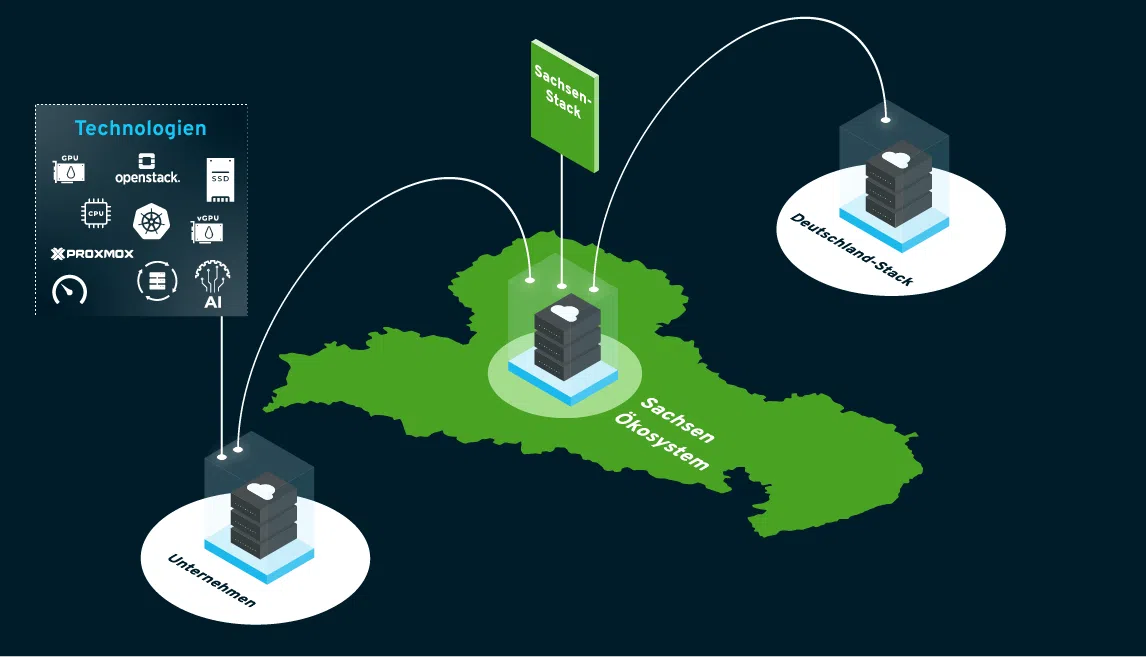
Not in this case. The Sachsen Stack isn't a competing architecture, especially not alongside initiatives like the Deutschland Stack. The relationship between the two is complementary, not competitive.
The Deutschland Stack provides a common foundation for digital solutions in Germany: a framework of interoperable, sovereign and open building blocks and standards. The Sachsen Stack, in turn, makes visible the companies, expertise and products that already contribute to those building blocks. Put simply: the Deutschland Stack describes the architecture; the Sachsen Stack showcases an ecosystem that builds it.
This distinction matters, because a stack isn't only technology; it also needs organizations that develop, integrate and operate it. Many companies in Saxony are already active in exactly these areas, and their offerings align naturally with key components of the Deutschland Stack, particularly at the infrastructure layer: open-source technologies such as OpenStack and Kubernetes, and standards like the Sovereign Cloud Stack (SCS), are already used to build offerings that are part of the Sachsen Stack today.
The interesting observation, then, isn't that Saxony has created an alternative stack, but rather that many of the ingredients for a sovereign digital infrastructure are already here: cloud infrastructure and open-source expertise, identity and security, automation, networking and storage, hardware, training, AI platforms, consulting and operations. The Sachsen Stack simply makes this ecosystem easier to recognize and connect.
The Geography of Digital Sovereignty
Digital sovereignty is often discussed as if it begins with complex architecture diagrams. But it ultimately depends on something more tangible: people who can build and operate systems, companies that invest in good technological approaches, teams that write support contracts and teams that deliver on them.
Saxony has a notably dense concentration of exactly these capabilities, even if they don't always get the attention they deserve: cloud providers, application developers, system integrators, open-source contributors, research institutions and consulting companies. Some build infrastructure. Some build platforms. Some build applications. Together, they make sure that digital infrastructures keep running on Monday morning.
There's a further advantage that rarely shows up in architecture diagrams: proximity. In a regional ecosystem, partners know each other, projects find suppliers faster and ideas become products more easily. Regionality doesn't solve technical problems by itself but when expertise is concentrated, collaboration gets a lot easier.
So, what's next for the Sachsen Stack?
Giving something a name is only the first step. The Unternehmensverband Digitalwirtschaft Sachsen is now working to drive the use of the Sachsen Stack forward, both within Saxony and beyond.
At the beginning of July, the association held a kick-off workshop in Leipzig, presenting a small group of regional organizations with use cases involving national and regional public institutions, alongside ideas for further lighthouse projects.
The goal is not just visibility, but connection: helping public institutions and private companies find the right combination of Saxon providers for their specific needs, while helping companies discover where their own offerings complement one another. The association is keeping up the momentum. Beyond joint participation in several upcoming events, it's also planning its own conference at the beginning of October.
The Sachsen Stack didn't need to be built from scratch. It needed to be named, connected and made visible. This work has only just begun.