

- This event has passed.
The Saxony Digital Economy Business Association presents its role in the digitalisation of public administration at ITOF
Together with other representatives of the Business Association Digital Economy Saxony we present the Saxony Stack at ITOF 2026 in Dresden, where we will be demonstrating how we are already helping to drive forward the digitalisation of public administration in Saxony.
Sachsen-Stack: What is the business association presenting at ITOF?
In the Sachsen-Stack, Saxon companies in the digital economy pool their Technologies, products, expertise and services, which together cover large parts of a modern, sovereign digital infrastructure – from hardware, through cloud infrastructure and cloud platforms, to applications, cyber security, consultancy and operations. It highlights the contribution Saxony is already making to digital infrastructure today, and serves as a reminder that innovation does not arise solely in the headquarters of international hyperscalers or global tech hubs. Rather, it also arises in Dresden, Leipzig or Chemnitz.
Saxony: a leading exporter of innovative solutions
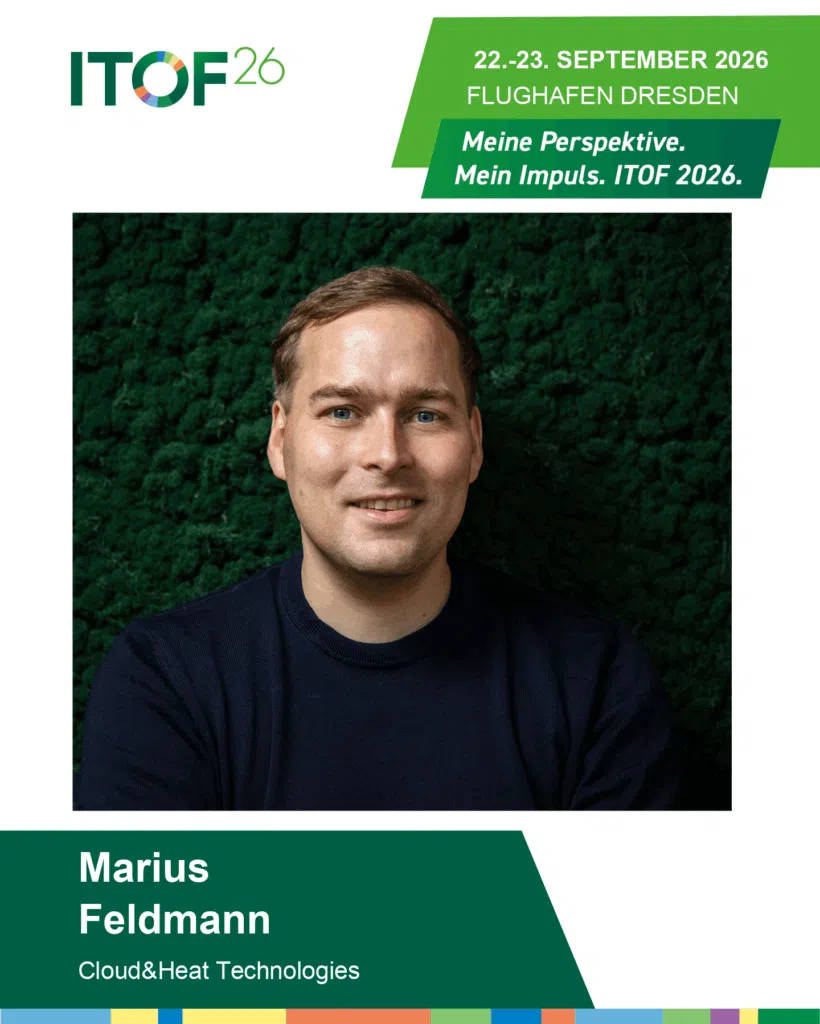
In addition to our involvement at the business association’s stand, our COO, Dr Marius Feldmann, will be at the Wednesday, the 23.09.2026 from 1.30 pm – 2.30 pm a talk on the subject of „“Saxony as an Exporter of Digital Sovereignty – A Impulse from the Digital Economy" hold.
What is Marius’s talk about?
Not least because of the major shifts in global politics, Europe has turned its attention to establishing digital sovereignty.
Many initiatives are aimed at reducing dependence on individual IT service providers in the public and private sectors.
Prompted by concerns about dependence on non-European powers, the issue has gained enormous momentum.
This presentation aims to offer a different perspective by viewing digital sovereignty initiatives not as a reaction to increasing dependence on individual providers, but as an enormous opportunity available to the Free State of Saxony in the current situation. The presentation will address the opportunities presented by sovereign IT solutions for both users and providers.
Following an overview of the topic, the Free State of Saxony’s open-source strategy is briefly examined; this strategy is a key lever for reducing dependencies and promoting transparent, reusable IT infrastructures. Furthermore, the role and activities of Saxony’s IT associations will be examined, such as ALASCA, which represents the interests of open-source and cloud ecosystems, the Saxon Digital Economy Association, which collectively represents the interests of the regional sector, and Silicon Saxony, one of Europe’s largest microelectronics and IT networks. The presentation then examines the economic potential that digital sovereignty offers the Free State of Saxony, looking beyond the hype surrounding the topic. It concludes with a call to harness this potential in a holistic manner. Overall, the aim of the presentation is to demonstrate how Saxony’s existing strengths and initiatives can contribute to digital sovereignty beyond the state’s borders: Saxony as an exporter of sovereign solutions.
About ITOF2026
In order to drive forward the digital transformation through collaboration between the state, the business sector and society, the Free State of Saxony is committed to providing comprehensive, efficient and user-friendly digital public services.
ITOF 2026 brings together the expertise of key stakeholders to address challenges such as end-to-end digitalisation, modern IT infrastructures, AI and digital sovereignty. The aim is to develop concrete approaches to process optimisation and sustainable modernisation, with a view to strengthening public trust in the state by reducing bureaucracy and improving service quality.
The full programme is available here: https://www.itof.sachsen.de/programm-4014.html
Tickets for the ITOF are available here: https://buergerbeteiligung.sachsen.de/portal/egov/beteiligung/themen/1064700
We look forward to discussing the Sachsen-Stack, the activities of the business association, as well as OpenStack, Kubernetes, Proxmox and digitally sovereign cloud infrastructures.