The German heating supply is currently still predominantly based on fossil fuels. In 2024, renewable energies only covered 18 % of the heating demand [1]. In order to achieve climate neutrality in the heating sector, industrial waste heat is becoming increasingly important as a supplementary resource. Data centres are particularly relevant in this context, as they are one of the fastest-growing sectors. This is why the German Energy Efficiency Act, passed in 2023, stipulates the mandatory use of waste heat for new data centre buildings by means of the Energy Reuse Factor (ERF). A forecast by the Borderstep Institute on behalf of the German Ministry of Economic Affairs and Climate Action estimates the usable amount of waste heat at 1 TWh/a in 2030 and 10 TWh/a in 2045. Figure 1 compares this value with the demand forecast for district heating.
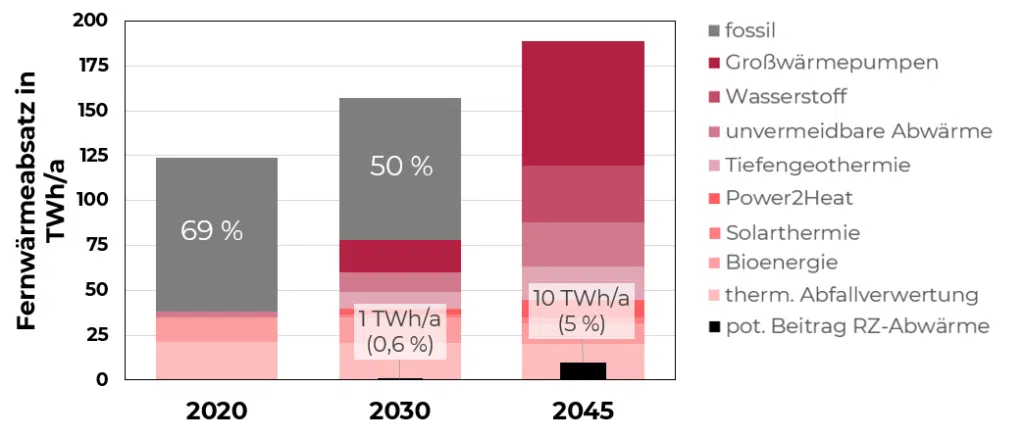
Figure 1: Potential contribution of data centre waste heat using the example of the demand forecast for district heating by 2045 (Germany)
Data sources: "Main Report 2023“, AGWF, 12/2024 [2] and "Status and development of Germany as a data centre location“, German Ministry of Economic Affairs and Climate Action, 01/2025 [3].
In this article, we explain the concept of the energy reuse factor and highlight the requirements of the German Energy Efficiency Act. We also highlight the impact on data centres and On-premises cloud infrastructures, as well as the most important factors influencing the feasibility of waste heat utilisation.
What does ERF mean? - The definition according to the standard
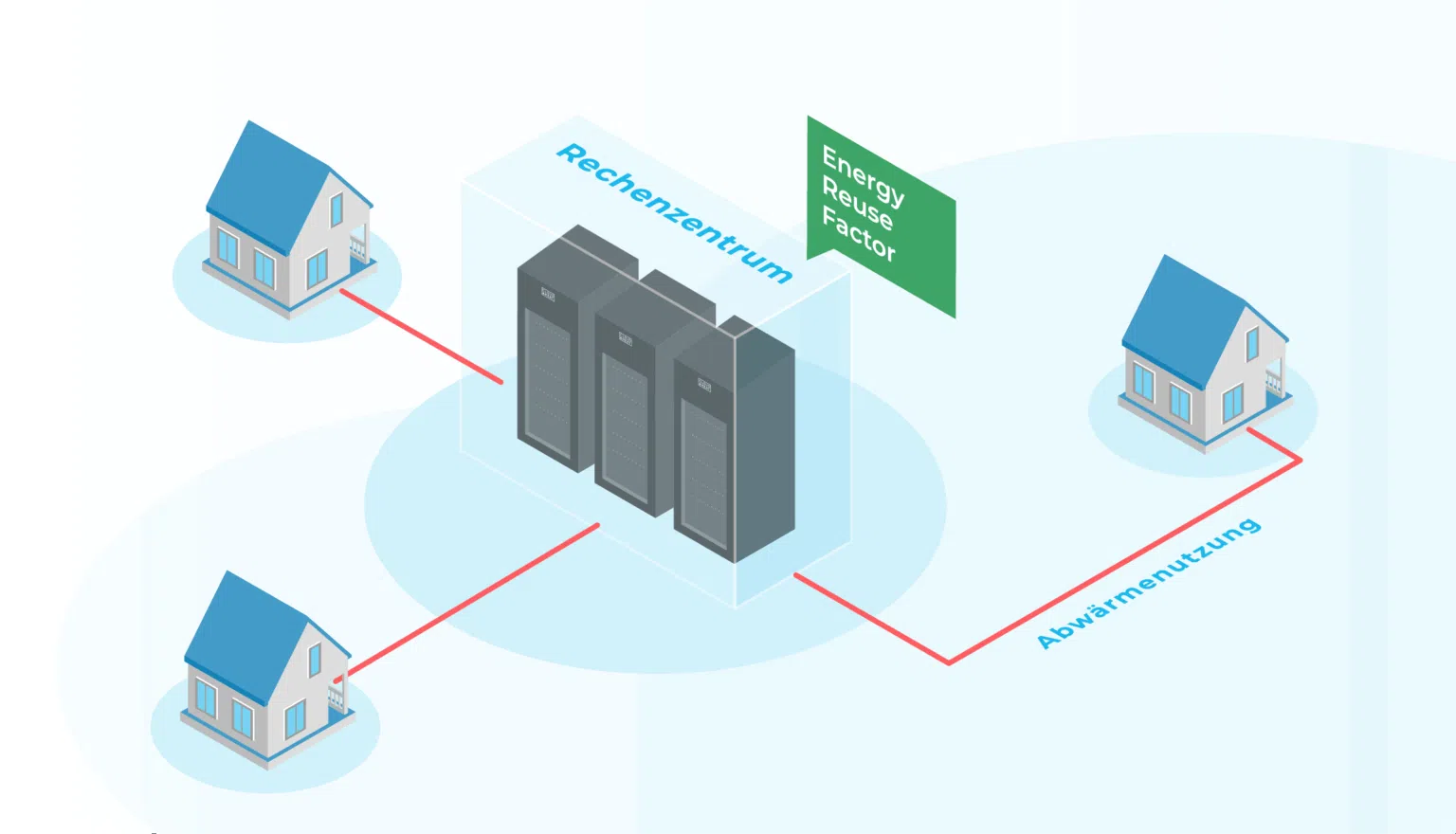
ERF stands for "Energy Reuse Factor“, a performance indicator for the reuse of energy. It is defined in DIN EN 50600 4-6 / ISO 30134-6.
It is is the proportion of a data centre’s annual total energy consumption that is reused as thermal energy. The data centre draws electrical energy and converts it into thermal energy through computing processes and losses. Consequently, the reusable energy is available as heat.
The value range of the ERF lies between 0 and 1. An ERF of 1 means that 100 % of the total energy consumption is reused on an annual average, for instance as waste heat in a heating network.
In order for the energy to count as reused two conditions must be met:
- The energy must be reused outside of the data centre. Reuse within the data center only impacts its energy efficiency by improving the PUE (Power Usage Effectiveness), for examply by saving heating energy.
- The energy must be used to completely or partially replace another energy source.
What does the German Energy Efficiency Act stipulate with regard to the ERF?
The Energy Efficiency Act adopted on 21 September 2023 introduces minimum ERF values for new data centre buildings. Existing data centres remain unaffected. The minimum values will gradually increase from 10 % (07/2026) to 15 % (07/2027) and finally to 20 % (07/2028).
It should be noted that only data centres with a nominal connected load of at least 300 kW are considered data centres for this purpose. This often exempts smaller on-premise infrastructures and edge data centres from the obligation to reuse waste heat. However, waste heat utilisation can still make sense in these cases: particularly in the case of nearby heat sinks, the extraction of waste heat is sometimes less complicated than assumed.
What exceptions are there for the ERF requirements in the German Energy Efficiency Act?
Operators are exempt from fulfilling the minimum value under the following conditions:
- Subsequent events that are not responsibility of the operator
- Concrete prospect that a heating network still to be built will absorb the heat in 10 years at the latest
- Non-acceptance by the heating network operator despite all technical requirements being fulfilled
Technical feasibility of waste heat utilisation
How easy it is to use waste heat in the data centre depends not only on the spatial layout but also primarily on the type of cooling system.
In new data centre buildings, one of the following three cooling systems is recommended for energy efficiency reasons:
1) Air cooling: With direct air cooling, fresh air is drawn in, filtered and channelled over the servers. In indirect exchange with the ambient air, the air circulates within the data centre and transfers its energy to the ambient air (or another heat sink) via a heat exchanger.
2) Indirect liquid cooling: In this concept, there is a circuit with a cooling liquid in the data centre that cools the air in the server room via heat exchangers.
3) Direct liquid cooling: In this case a cooling liquid is channelled directly over the majority of the heat-generating components in the server (e.g. CPU).
The typical temperature level of the waste heat depending on the cooling method is shown in Figure 2.

Figure 2: Temperature level of the waste heat for different cooling concepts
In case 1, the heat is captured from the air flow in order to utilise it. Air/water heat exchangers often require a lot of space, which is why retrofitting is often difficult.
In case 2, it is possible to capture the heat from the air (see case 1) or from the existing cold water network. In this case, the temperature level of the waste heat is comparatively low and often has to be raised by a heat pump. However, the water/water heat exchanger is much more compact and less expensive.
Case 3 is the best one from the point of view of waste heat utilisation: the waste heat can be captured from a liquid cooling circuit, enabling the heat exchanger to be compact. In addition, the waste heat generally has a high temperature level of 40 - 60 °C. Depending on the heat sink, either no heat pump is required or it is only required to run at a more favourable operating point.
Selection of the heat sink
Various options are available as heat sinks, depending on the temperature level and amount of waste heat (see Figure 3).

Figure 3: Selection of possible waste heat utilisation scenarios
Whether a specific waste heat utilisation project is feasible for all project participants depends on many factors that need to be considered individually. In addition to temperature level and power, the seasonality of the heat sink, for example, is decisive. If the heat is to be used primarily for heating purposes, the demand in summer is much lower. This makes it more difficult to maximise the ERF on an annual average. Nevertheless, waste heat utilisation for heating purposes is one of the main areas of application. In principle, potential heat sinks should be evaluated when selecting the location of the data centre.
Contractual and legal framework conditions
In addition to technical and economic aspects, the contractual arrangements between the data centre operator and the potential heat consumer are often a factor of uncertainty. Although the initial situations are usually very project-specific, some general recommendations can be formulated:
- The sooner discussions start, the better: local authorities are currently drawing up their municipal heating plans, new-build districts are looking for economical and reliable heat sources to meet legal requirements and energy suppliers are planning to decarbonise their heating networks. Under these conditions, clarifying responsibilities at an early stage is crucial for the smooth running of a project.
- Heat pricing should be based on the production costs. Giving away waste heat free of charge can currently lead to challenges under VAT law [4].
- Support is provided by various state energy agencies, which can help with sample contracts or practical examples. In Hesse and Baden-Württemberg in particular, extensive experience is already available based on projects that have already been carried out.
Outlook
As a company with many years of experience in the use of waste heat from data centres - this aspect has been firmly anchored in our business model since our foundation - we are familiar with the many challenges that successful implementation entails. In addition to the points mentioned above, there are numerous other facets to consider, such as
- What is the load profile of the data centre?
- Under what conditions does a project become profitable?
To shed light on these and other questions, we regularly offer a two-hour webinar entitled Green waste heat from data centres. Interested parties are welcome to register for one of the available dates or contact us directly.
Further literature
The Open Compute Project has a Heat Reuse Workstream focused on the topic of waste heat utilisation. There are several collaboratively developed documents available for free, including a white paper on reference designs for waste heat utilisation published in 2025 [5].